Posts
Florida’s Condo Compliance Divide: What Every Board Must Know Before 2026 Closes

By the time most condo boards in Florida started paying attention, their deadlines had already passed.
As of 2026, the Florida market has split into a Compliance Divide. On one side: buildings with sealed Milestone reports and clean insurance renewals. On the other: the estimated 50% of qualifying buildings that remain in a state of non-compliance, facing policy cancellations, lender blacklists, and unit values collapsing as they become cash-only assets.
Surfside didn’t create Florida’s condo crisis; it revealed one that had been building for decades, deferred maintenance, and underfunded reserves. The question facing your board isn’t whether to comply. It’s whether you still have time to do it right.
This guide breaks down exactly what’s required in 2026, and where most associations are quietly falling behind.
From Paperwork to Personal Liability
Two legislative shifts drove this change: Senate Bill 4-D and Senate Bill 154.
Today, these reforms are no longer upcoming changes; they are active laws with strict enforcement. Missing a deadline is no longer just a paperwork error. It can lead to legal action, insurance denials, and breach of fiduciary duty claims against board directors under Florida’s Condominium Act.
Florida Condo Compliance Timeline & Key Requirements
The following table summarizes the primary compliance requirements under the Florida Condominium Act (Chapter 718) and Florida Statute 553.899, as established by SB 4-D and refined by SB 154 and HB 913.
| Requirement / Change | Applies To | Deadline / Trigger | What It Means for Owners & Associations |
|---|---|---|---|
| Milestone Inspection (Initial) | Condo buildings ≥ 3 habitable stories | At 30 years of age (or earlier if required locally) | Mandatory structural inspection by a licensed engineer or architect. Ground-level parking and crawl spaces do not count toward the story threshold. |
| Coastal Inspection (Local Discretion) | Buildings within 3 miles of the coastline (subject to local enforcement) | 25 years (if triggered locally) | SB 154 removed the automatic 25-year rule. Local building departments may require it at 25 years if environmental conditions justify it. |
| Phase 1 Inspection | All qualifying buildings | Within the required timeframe, upon reaching the age threshold | A visual, non-destructive inspection by a licensed engineer or architect. The inspector checks for signs of Substantial Structural Deterioration. |
| Phase 2 Inspection (if required) | Buildings with identified concerns in Phase 1 | Within 180 days of Phase 1 report | More intensive, often destructive testing to determine the extent of structural issues. Findings directly dictate the association's repair costs. |
| Recurring Milestone Inspections | All qualifying buildings | Every 10 years after initial inspection | Ensures buildings maintain their certified safety standard over time. No exemptions once the initial inspection threshold is reached. |
| Structural Integrity Reserve Study (SIRS) | Condo associations ≥ 3 habitable stories | December 31, 2025 (See Pro Tip below for 2026 extensions) | A physical, on-site assessment covering 8 structural components by a licensed engineer or architect. Must be updated every 10 years. |
| Mandatory Reserve Funding | SIRS components only | Effective January 1, 2026 | Associations can no longer vote to waive or reduce reserves for structural items. Full funding per the SIRS recommendation is now required by law. |
| HB 913 Funding Flexibility | Associations with high repair costs | Ongoing | Allows a temporary pause or reduction of reserve contributions for up to two consecutive budget years. Requires majority owner vote and a completed Milestone Inspection within the previous two years. |
| Non-Compliance Consequences | All applicable buildings | Ongoing | May result in unsafe-for-occupancy designations, insurance non-renewals, Fannie Mae/Freddie Mac financing restrictions. Individual board directors may face personal fiduciary liability. |
PRO TIP: While the standard SIRS deadline is Dec 31, 2025, Florida law provides a bundling option. If your building’s Milestone Inspection is due in 2026, you can coordinate both studies to be completed by December 31, 2026.
The table outlines what’s required and when. What follows is what it actually looks like when an engineer shows up at your building, and what triggers the expensive path.
The Two Phases of Structural Evaluation
A Milestone Inspection is designed to catch problems before they become catastrophes. It is split into two distinct phases.
Phase 1: The Visual Check
Phase one is primarily a visual inspection performed by a licensed engineer or architect. The inspector evaluates the foundation, load-bearing walls, and roofing system, searching for any visible signs of distress that could point to a deeper problem.
If no issues are found, a report is filed with the local building official and the building is cleared for another 10 years. If the engineer sees anything suspicious, the building must proceed to Phase Two.
Phase Two: Detailed Structural Evaluation
If the engineer identifies signs of substantial structural deterioration during Phase 1, the law mandates a Phase 2 Inspection. This phase is much more technical and may involve core sampling or ultrasound testing to check the internal strength of concrete and steel.
The goal is to determine the exact extent of repairs needed. These findings directly dictate the association’s costs in the years ahead.
Defining Substantial Deterioration in 2026
The term substantial deterioration is the legal trigger for invasive and expensive testing. It does not refer to old carpet, peeling paint, or outdated aesthetics in the common areas.
Under Chapter 718 of the Florida Statutes, it generally refers to structural distress that affects the building’s integrity. This commonly includes concrete spalling caused by corrosion of reinforcing steel, where embedded steel components rust and expand.
This happens when salt air gets into the walls and rusts the steel rebar. The rusting metal expands and can lead to cracking and separation of the surrounding concrete.
The Significant Financial Impact
For decades, Florida condo boards had a pressure valve: when reserve contributions got uncomfortable, owners could simply vote to waive them. It kept monthly fees low and conflict off the agenda. It also quietly built a structural debt that is now coming due all at once.
That valve is permanently closed as of January 1, 2026.
Boards must now fully fund every reserve component identified in their SIRS, no exceptions, no owner votes to the contrary.
For many associations, this is the first time the true cost of the building has appeared on a budget. The numbers are not small.
For example, a mid-size 40-unit building with $1.2M in identified SIRS components is looking at roughly $2,500 per unit annually in reserve contributions alone before operating costs, insurance premiums, or any active repair assessments.
For larger coastal buildings with salt-air deterioration already identified, that number climbs significantly higher.
Buildings that have consistently funded reserves over the years are absorbing this transition. Buildings that waived them repeatedly are now facing a compressed catch-up, and in some cases, immediate special assessments on top of the new reserve requirements.
The compounding problem is timing. A board that discovers structural deterioration during its Milestone Inspection must fund the repairs and maintain SIRS reserve contributions simultaneously. There is no sequencing relief built into the law; both obligations run concurrently.
The HB 913 Relief Valve & Its Limits
The 2025 legislature acknowledged this pressure with HB 913, which allows associations to temporarily reduce or pause reserve contributions for up to two consecutive budget years, but only under specific conditions.
Eligibility: The association must be unit-owner-controlled, have completed its Milestone Inspection within the previous two years, and the pause must apply to a budget adopted on or before December 31, 2028.
The Trigger: A majority of the total voting interests of the association must vote to approve the pause.
The Purpose: All freed-up cash must be directed toward immediate life-safety repairs identified in that Inspection.
The Requirement: Before reserve contributions resume, the association must perform an updated SIRS to recalculate the funding plan.
This is not a waiver. It is a short-term reallocation tool for boards actively repairing their buildings, not a mechanism to delay compliance. Boards that treat HB 913 as a budget relief measure rather than a repair tool remain personally exposed to fiduciary liability.
The bottom line: HB 913 gives boards a controlled way to sequence urgent repairs ahead of reserve accumulation. It does not give them a way out.
Did You Know? If a local building official declares a condominium uninhabitable, the board can pause reserve funding immediately, without a unit owner vote.
What Non-Compliance Actually Costs
Local authorities are actively enforcing these requirements, and the consequences of missing a deadline are immediate.
This happened at Crestview Towers in North Miami Beach, where 300+ residents were given three hours to evacuate after the city received an engineering report deeming the building structurally and electrically unsafe. Many didn’t return home for nearly four years.
Furthermore, the insurance market has tightened; most carriers now require proof of a completed Milestone Inspection and SIRS. In some cases, insurers may decline to renew policies for buildings that do not meet inspection and maintenance standards.
These consequences aren’t reserved for buildings that ignored compliance entirely. Many of the associations facing them today made smaller, procedural mistakes that compounded quietly over time.
Where Most Associations Are Falling Behind in 2026
As we move deeper into the 2026 compliance cycle, common pitfalls are emerging that put boards at risk of regulatory issues and unexpected financial pressure.
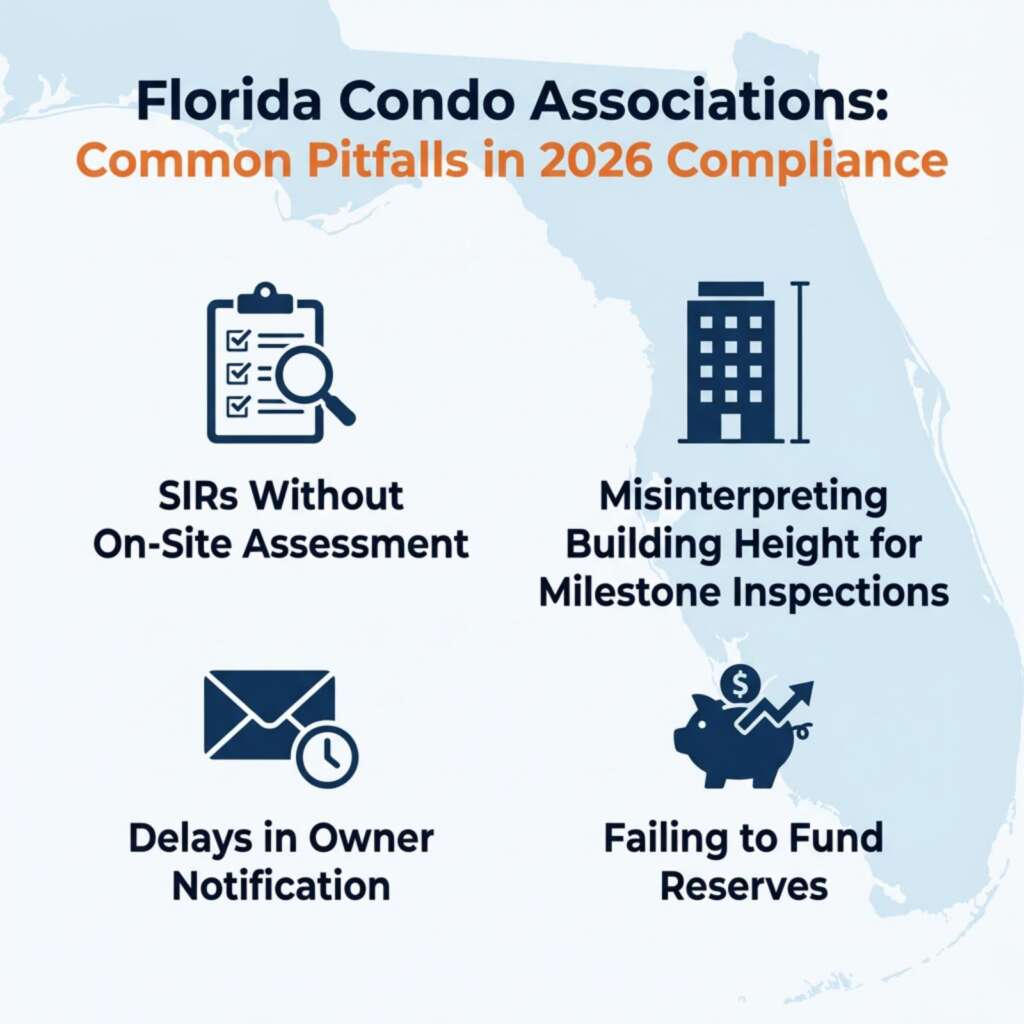
- The Paperwork Only Trap: Some associations treat the SIRS as a financial accounting exercise only. However, Florida law requires a SIRS to be based on a physical visual assessment of the property. If your study is completed without on-site engineering evaluation, it may not satisfy the requirements of regulators or insurance carriers.
- The Habitable Story Confusion: Recent legislative updates (HB 913) clarified that Milestone Inspections apply to buildings with three or more habitable stories. Some associations wrongly assume they are exempt due to ground-level parking or crawl spaces. Misinterpreting building height can lead to missed deadlines and serious compliance issues.
- Delays in Owner Notification: The clock starts the moment you receive your report. Florida law mandates a 45-day window for associations to distribute the inspector’s summary to every unit owner. Boards that delay this process while assessing next steps often find themselves in violation of statutory timelines, increasing their legal exposure.
- The Funding Fallacy: Completing a SIRS on time is only half the requirement. The mistake boards make is treating the study as the finish line. The law requires both the study and full reserve funding from January 1, 2026. Having the report without the funding leaves the board just as exposed as having neither
Why the Engineering Partner You Choose in 2026 Matters
Most engineering firms hand you a sealed report and consider their job done. What happens next (the owner notifications, the reserve recalculation, the insurance documentation, the board liability) lands entirely on you.
That gap between the inspection finding and the funded repair plan is exactly where associations get into trouble. And in 2026, with enforcement active and insurers scrutinizing every submission, the cost of that gap has never been higher.
GreenWorks closes it.
Engineering Authority: With 175+ licensed Engineering and Design professionals, we deliver the structural seals required for Phase 1 and Phase 2 Milestone compliance, not visual assessments dressed up as engineering reports.
Same-Day Reporting: The 45-day owner notification clock starts the moment your report is received. Our same-day delivery ensures your board has every hour of that window.
Turnkey SIRS Support: We don’t hand you a technical document and leave you to interpret it. We translate engineering findings directly into a reserve funding roadmap your board can present to owners, insurers, and lenders with confidence.
One point of contact. Full compliance.
Want to see what a GreenWorks engineering report looks like before you commit? View sample reports here.
Buildings that acted in 2024 are renewing insurance and closing sales. Buildings that are still deciding are becoming cash-only assets. Which side of the Compliance Divide your building sits on is still your choice, but the window is closing.
Book Your 2026 Compliance Strategy Session.
Let’s review your current inspection status and funding plan to ensure your association stays safe, solvent, and compliant.